The Jesuit Who Sent Jingdezhen's Porcelain Stories to Europe
2026-11-24
In his second letter about Chinese porcelain, François-Xavier d’Entrecolles admitted that he had been wrong. Ten years earlier, he had described how a prized red glaze was made. Now he had more information—and a correction to send to Europe.
“I was mistaken,” the French Jesuit wrote, in a translation published in 1906. The colour, he explained, came from copper rather than the substance he had identified before. Even then, he could not give a complete account: the people who knew the preparation were careful not to disclose it.
The correction is easy to miss in a long report crowded with workshops, materials and finished wares. But it reveals something important about the two letters d’Entrecolles wrote in 1712 and 1722. They were not the work of a man who had unlocked every secret in a single visit. They were records of questions, conversations and observations gathered over time in China’s porcelain-making centre, Jingdezhen.
How a missionary came to write about Jingdezhen porcelain
D’Entrecolles, known in Chinese as Yin Hongxu, was a French Jesuit missionary in Qing China. His work brought him into contact with Chinese Christians, including people who made and traded porcelain. Some worked in Jingdezhen, a city in Jiangxi whose workshops supplied buyers far beyond the region.
His first substantial porcelain letter, addressed to the Jesuit procurator Father Orry, was dated September 1, 1712, from Raozhou, the prefectural city associated with Jingdezhen. It is tempting to imagine an outsider walking into a workshop and seeing everything for himself. His own account was more complicated.
He described visiting Jingdezhen to attend to his congregation, watching work, asking questions and consulting Chinese writings. In an English translation published by ceramic writer William Burton, he credited several Christian converts who worked in porcelain or traded in it with providing details he had not seen himself. He also described checking information against a local history of Fuliang, the county to which Jingdezhen belonged.
The letter therefore carried more than one person’s knowledge. D’Entrecolles selected and organized what he learned, but the skilled workers, merchants and Chinese texts he consulted shaped what could be sent abroad. Most of the people who answered his questions are not named in the surviving account.
The porcelain workers behind one small cup
One of the first letter’s most memorable passages follows an ordinary cup through a workshop. The person at the wheel did not necessarily make a finished cup from beginning to end. D’Entrecolles described a succession of workers: one gave the clay its initial shape, another handled the piece, another worked with a mould, and another trimmed and refined it.
He had been told that a finished piece could pass through the hands of seventy workers. That figure was reported to him, not a count the letter establishes for every object. What he could observe was a striking division of tasks: a vessel became a collective achievement before it reached a kiln.
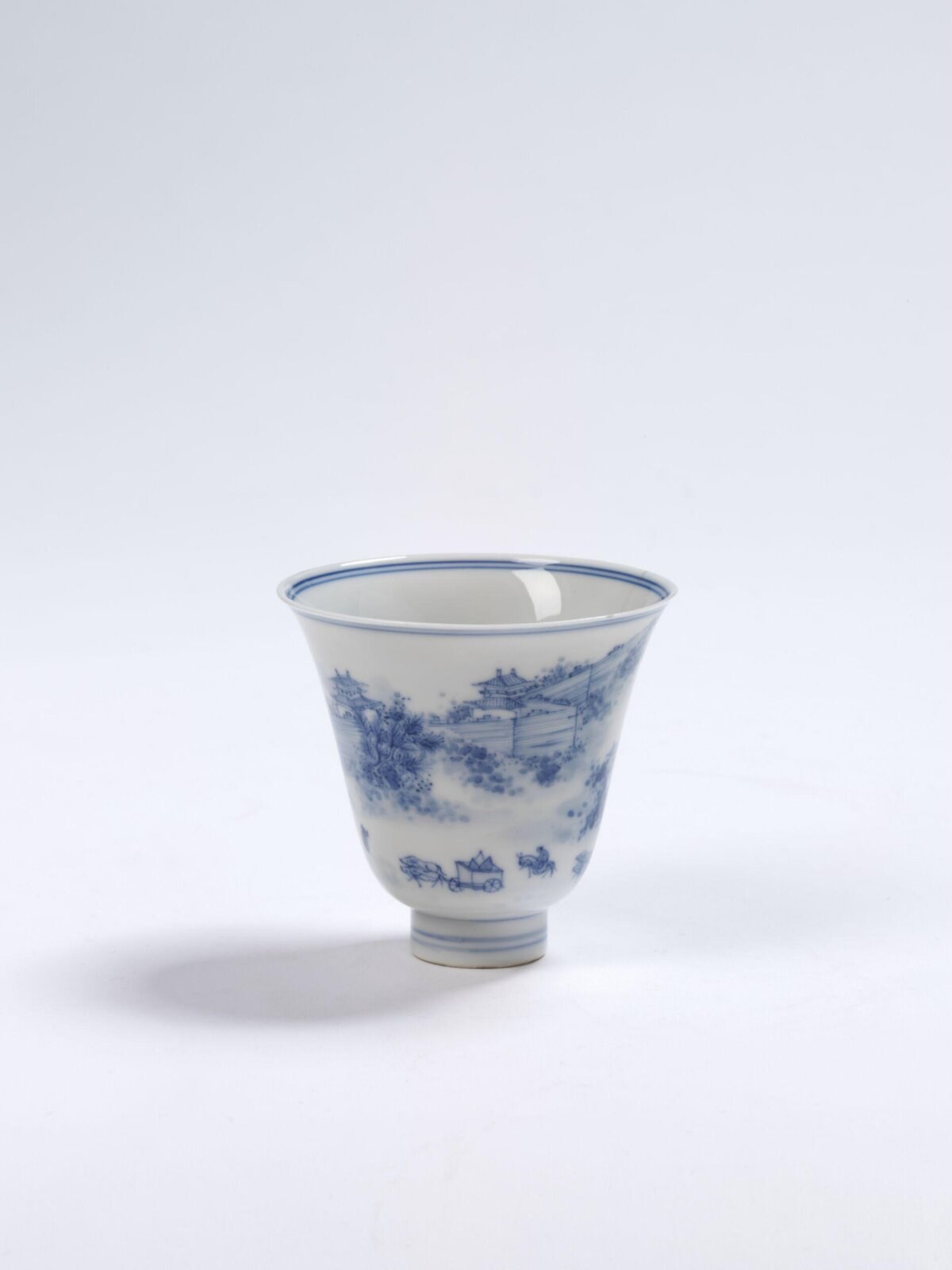
Image Source: Victoria and Albert Museum, London. This cup dates from about 1710–1722; it is an example from the period, not an object identified in the letters.
He also noticed a practical consequence of that organization. Preparing and kneading the porcelain body was hard work, and, he wrote, Christian workers in that job found it difficult to attend church unless someone could take their place. If one stage stopped, other workers could be held up too.
That observation came from a missionary concerned about his congregation, not from a neutral survey of labour conditions. It nevertheless gives the account a human scale: the porcelain admired by distant buyers depended on people whose working days had to fit around one another.
What d’Entrecolles saw and what he was told
The letters are rich in detail, but d’Entrecolles did not always claim the same kind of access. He described materials arriving as small white blocks, workers washing and preparing them, painters dividing decoration between specialists, and fragile pieces being placed in protective clay containers for firing. In other places, he repeated what workers or merchants told him.
His description of the unfinished cup is particularly vivid because it follows a piece that most buyers would never see: an imperfect clay form passing quickly from hand to hand. Elsewhere, his attention turns to risks. In the first letter he described kilns whose contents could be damaged or lost in firing, and orders for unusual European shapes that could be difficult to sell locally if rejected.
These passages are not a complete record of every Jingdezhen workshop. They are a visitor’s view, filtered through his questions and the people willing or able to answer them. His judgments about Chinese painters also reflected his own European assumptions; they should not be mistaken for an objective measure of their skill.
Still, the specificity matters. His account gives readers more than a list of ingredients. It shows a place where a cup, a firing failure and an export order belonged to the same busy chain of work.
The second letter—and a correction about red glaze
D’Entrecolles wrote again on January 25, 1722, this time dating the letter from Jingdezhen itself. He opened by saying that his earlier enquiries had not exhausted the subject. The new account gathered observations as he encountered them, whether in workshops or from questions put to Christian workers.
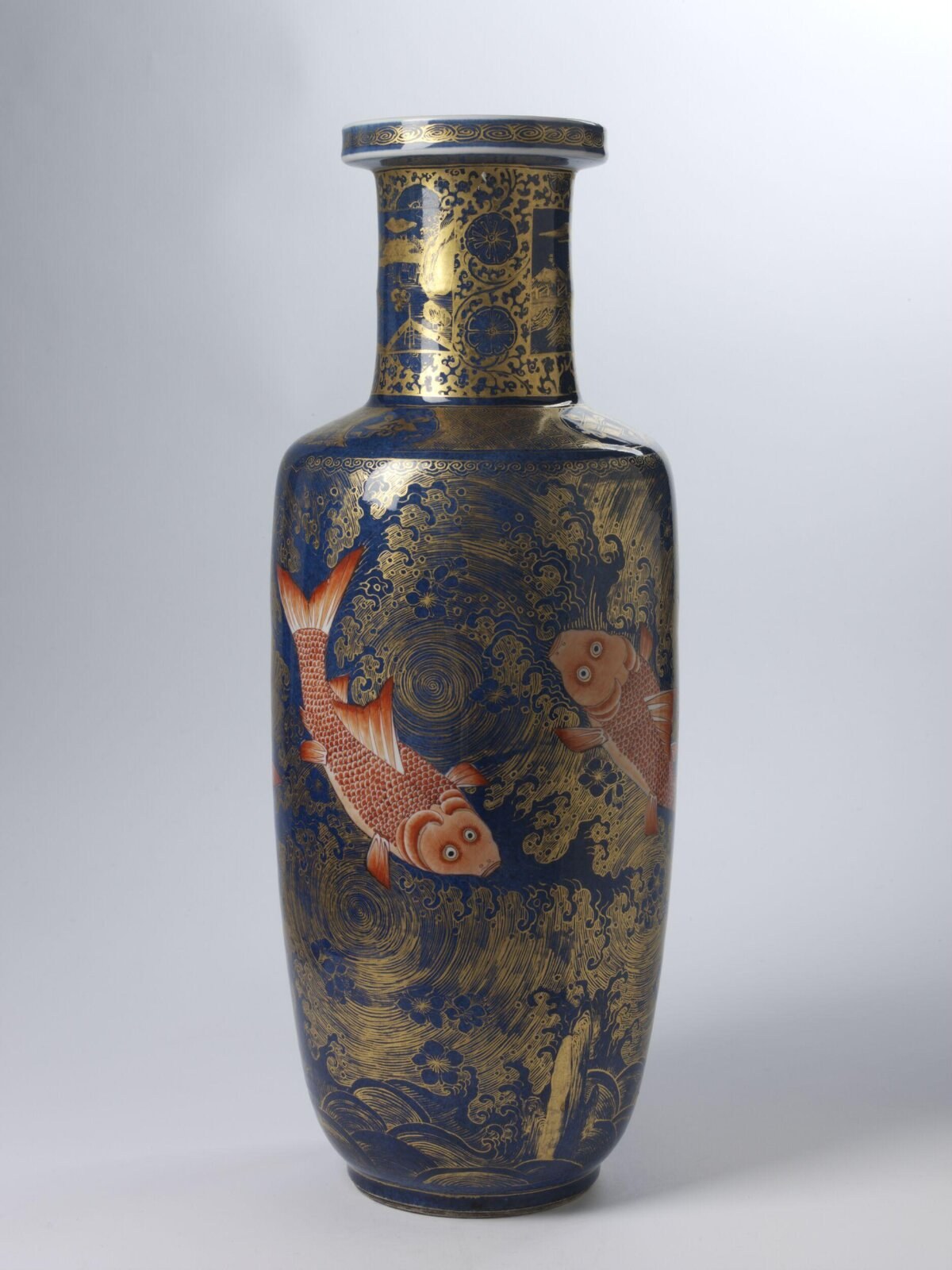
One addition concerned the way workers applied colour by blowing it through gauze over a tube. He described powder-blue decoration as well as blown red, and noted a practical detail: a sheet of paper placed beneath a vase could catch the falling blue pigment so it could be gathered and used again.
Then came the red-glaze correction. In 1712, d’Entrecolles had associated a particular red glaze with a colour made from copperas, an iron compound. In 1722, he said that account was mistaken and described copper as an ingredient instead. He also admitted that he still had not learned how all the ingredients were prepared.
The distinction matters. A letter can preserve useful information without being a complete recipe, and a writer can correct an error without having solved every remaining problem. His second report is valuable partly because it allows us to see that process of revision.
How the letters traveled beyond Jingdezhen
D’Entrecolles intended his observations to be useful to readers in Europe. The letters appeared in volumes of the Jesuit collection Lettres édifiantes et curieuses, the first in 1717 and the second in 1724. Later editions and translations brought their descriptions to wider audiences, including people who might have seen the finished wares without knowing much about the workshops behind them.
That is different from saying the letters gave Europe porcelain. Hard-paste porcelain had already been developed in Saxony before the first letter was written, and the Meissen manufactory was founded in 1710. European factories continued to experiment with their own materials and methods. The letters belong to that wider history of curiosity, exchange and adaptation, not to a single moment when one person handed Europe a complete formula.
Their lasting interest is closer to the workshops themselves. D’Entrecolles noticed the clay being worked, the painters dividing a design and the blue pigment caught on a sheet of paper. He also left traces of the people who taught him, even when he did not preserve their names. Between his first report and his second, the story of Jingdezhen porcelain became not a final answer, but a conversation he was still trying to understand.
References
- D’Entrecolles, F.-X. (1906). The letters of Père d’Entrecolles: First letter, part 1 (W. Burton, trans.). In Porcelain: Its nature, art and manufacture. B. T. Batsford. Ceramics Today. https://ceramicstoday.glazy.org/articles/entrecolles_part1.html (Original letter dated 1712)
- D’Entrecolles, F.-X. (1906). The letters of Père d’Entrecolles: First letter, part 2 (W. Burton, trans.). In Porcelain: Its nature, art and manufacture. B. T. Batsford. Ceramics Today. https://ceramicstoday.glazy.org/articles/entrecolles_part2.html (Original letter dated 1712)
- D’Entrecolles, F.-X. (1906). The letters of Père d’Entrecolles: First letter, part 3 (W. Burton, trans.). In Porcelain: Its nature, art and manufacture. B. T. Batsford. Ceramics Today. https://ceramicstoday.glazy.org/articles/entrecolles_part3.html (Original letter dated 1712)
- D’Entrecolles, F.-X. (1906). The letters of Père d’Entrecolles II (W. Burton, trans.). In Porcelain: Its nature, art and manufacture. B. T. Batsford. Ceramics Today. https://ceramicstoday.glazy.org/articles/entrecolles2.html (Original letter dated 1722)
- Meissen. (n.d.). MEISSEN is born under the zodiac sign of Gemini. https://www.meissen.com/en/momentodetail/zodiac-sign-gemini
- Society for Asian Art. (2026). Fall 2026 Arts of Asia lecture series: Study guide [Bibliography]. https://www.societyforasianart.org/wp-content/uploads/2026/03/2026-09-18-Huang-Study-Guide.pdf
- Victoria and Albert Museum. (n.d.). Cup [Jingdezhen porcelain, ca. 1710–1722]. https://collections.vam.ac.uk/item/O144010/cup-unknown/
- Victoria and Albert Museum. (n.d.). Vase [Jingdezhen porcelain, 1700–1710]. https://collections.vam.ac.uk/item/O144408/vase/
- Yu, P.-C. (2017). The decoration of porcelains and related issues seen in the letters of François-Xavier d’Entrecolles. National Palace Museum Research Quarterly, 34(3), 123–168. https://www.npm.gov.tw/en/down.ashx?sNo=10015292