The Belitung Shipwreck: A Dated Bowl and a Cargo of Chinese Ceramics
2026-11-24
Among the thousands of bowls recovered from the Belitung shipwreck, one carried a message that had nothing to do with the sea. On its outer wall were characters giving a date: the sixteenth day of the seventh month in the second year of the Baoli reign.
That year was 826. The inscription did not name the ship, its owner or its destination. But it gave researchers a point in time for a cargo that had spent more than a thousand years underwater off an Indonesian island.
The bowl was one small part of an extraordinary shipment of Chinese ceramics. Together, the vessels reveal not just what a ninth-century merchant might carry, but how ordinary bowls could become the largest part of a long-distance journey.
How the Belitung shipwreck came to light
In 1998, divers looking for sea cucumbers found evidence of an old wreck near Belitung Island, east of Sumatra. The discovery became known as the Belitung shipwreck; it is also called the Tang shipwreck or Batu Hitam, after a nearby reef whose name means “black rock.”
What lay below was not simply a scattering of broken pottery. The site contained the remains of a wooden ship and a cargo that included vast numbers of Chinese ceramic vessels. Finds ranged from everyday bowls to fine wares, together with metal objects and other goods.
The 1998 discovery is the point at which the wreck entered the public record, but the story may not have begun there. Researcher Natali Pearson has noted suggestions that local fishing families had already known of a “reef in which jars are growing.” It is a striking description, though the earlier history of local knowledge is not fully established.
After the discovery, the wreck was commercially salvaged over two seasons. The circumstances of that recovery later became a matter of debate among archaeologists and museums, including concerns about how much archaeological context could be recorded. That debate is part of the cargo’s modern history; it also makes careful attention to surviving evidence especially important.
A date written on one Tang bowl
The dated bowl came from the Changsha kilns in what is now Hunan province, in southern China. Its inscription refers to a year in the Tang dynasty’s Baoli reign, equivalent to 826 CE. Researchers use it as a clue to the age of the shipment: the vessel could not have been carried aboard before the date it bears.
This is a useful limit, not a complete timetable. An inscription does not tell us exactly when the bowl was loaded, how long the ship sailed, or the precise day it sank. Other objects and research help place the wreck in the ninth century, but the ship’s final voyage cannot be reconstructed from one date alone.
The bowl matters partly because it is so ordinary. It was not a royal monument with a long inscription explaining who commissioned it. It belonged among the kinds of ceramic vessels that could be produced in great numbers, decorated, packed and sent away from the kilns where they were made. Its written date gives a human-scale point of reference within a cargo counted in tens of thousands.
Why were so many Changsha bowls on board?
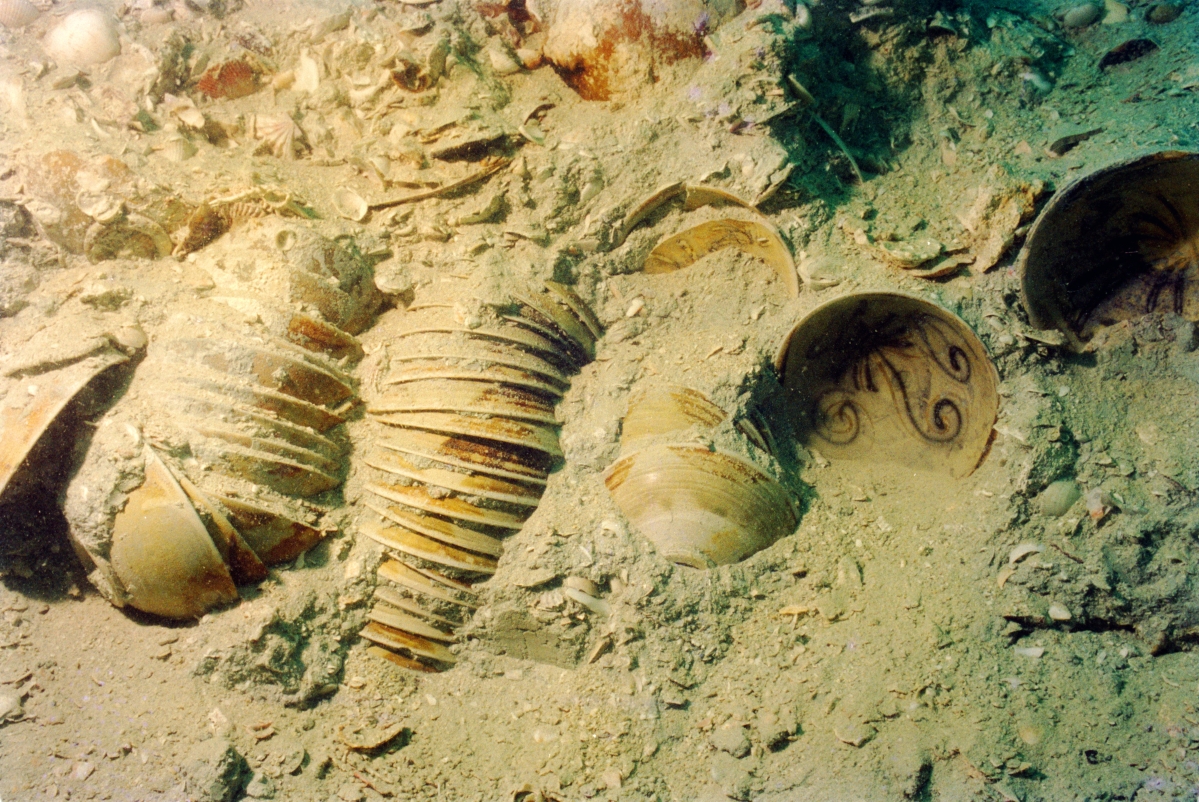
The cargo contained a remarkable concentration of Changsha ware. The Asian Civilisations Museum in Singapore describes more than 54,000 bowls of this type recovered from the Tang shipwreck. Their numbers make clear that these were not simply dishes for a small crew’s meals: they formed a substantial part of the goods being carried.
A typical surviving bowl is modest in size. One in the museum’s collection measures about 15 centimetres across and has painted foliage and spirals. Such vessels were made around Changsha, where potters used painted decoration beneath the glaze. The repeated forms made the bowls suitable for shipment in quantity, while the brushwork could vary from one vessel to another.
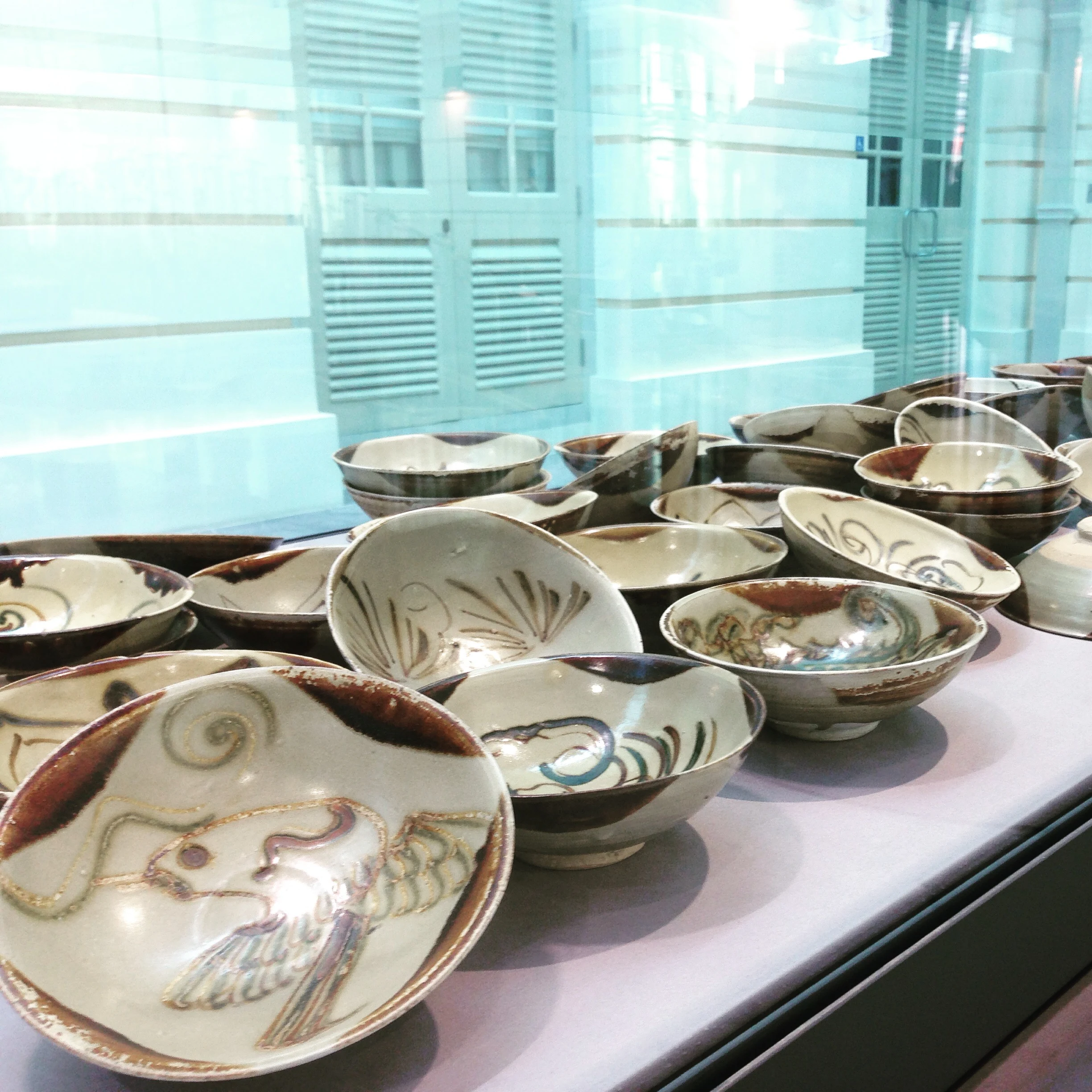
Image Source: Natali Pearson / Leiden Arts in Society Blog.
Look closely at one bowl and a detail might seem casual: a few lines, a leafy form, a splash of colour. Set it beside thousands of related bowls and a larger picture appears. Many makers were contributing to a shared commercial output, but the finished objects were not perfectly identical.
Some vessels even carried words rather than just painted designs. A Changsha bowl in Singapore’s national collection bears the inscription chazhanzi, meaning “tea bowl.” It is a small reminder that the shipment consisted of useful objects as well as things we now examine behind museum glass.
How the Tang ceramics were packed for a sea voyage
The size of the shipment created a practical problem. Bowls had to survive being moved, stacked and carried aboard a ship. Reports on the Belitung cargo describe stacks of bowls packed inside large storage jars, with straw used as cushioning. Even without knowing who arranged every jar, the packing shows that transporting fragile ceramics required organisation as well as buyers.
The cargo was not made up of Changsha bowls alone. The ship also carried green-glazed Yue wares and fine white wares associated with northern Chinese kilns. Alongside the comparatively numerous bowls were exceptional objects in gold and silver. The different materials and qualities show a cargo assembled from more than one source, rather than the output of a single workshop.
The ship’s own construction offers another clue. Its wooden planks were joined by sewing, a method associated with boatbuilding traditions of the western Indian Ocean. On board were Chinese ceramics; the vessel was found in Southeast Asian waters. Taken together, the ship and its cargo show goods and maritime knowledge meeting across a wide region.
That evidence does not identify every trader or prove the ship’s exact route. Scholars have proposed that it was carrying goods toward markets farther west, perhaps the Middle East. The precise port of departure, destination and cause of the sinking remain uncertain.
The Belitung bowls after their discovery
Following their recovery, the objects were acquired for a Singapore collection with support from the estate of Khoo Teck Puat. They are now associated with the Asian Civilisations Museum’s Tang Shipwreck Collection, where examples can be seen and studied together.
The scale of the surviving group changes how a visitor can look at a single bowl. One vessel may carry a date; another says “tea bowl”; many more repeat patterns with small differences. None can tell the entire story on its own. Together they preserve traces of workshops, packing and exchange that a single masterpiece might not show.
The dated Changsha bowl still leaves much unsaid. It cannot explain what happened in the final moments of the voyage or name the person who hoped to receive it. What it does offer is quieter and more tangible: a date made in China, carried onto a ship and found again beside thousands of other bowls far from the kiln.
References
- Asian Civilisations Museum. (n.d.). Tang shipwreck. https://www.acm.nhb.gov.sg/galleries/maritime-trade/tang-shipwreck
- Guy, J. (2010). Rare and strange goods: International trade in ninth-century Asia. In R. Krahl, J. Guy, J. K. Wilson, & J. Raby (Eds.), Shipwrecked: Tang treasures and monsoon winds (pp. 19–27). Arthur M. Sackler Gallery, Smithsonian Institution; National Heritage Board of Singapore; Singapore Tourism Board. https://asia-archive.si.edu/wp-content/uploads/2017/10/02Guy.pdf
- National Heritage Board. (n.d.-a). Bowl with ‘chazhanzi’ inscription. Roots. https://www.roots.gov.sg/collection-landing/listing/1314726
- National Heritage Board. (n.d.-b). Bowl with foliage and spirals. Roots. https://www.roots.gov.sg/collection-landing/listing/1307447
- Nord, K. (2017, May 9). Secrets of the sea: A Tang shipwreck & early trade in Asia. Antiques and The Arts Weekly. https://antiquesandthearts.com/secrets-of-the-sea-a-tang-shipwreck-early-trade-in-asia/
- Smithsonian’s National Museum of Asian Art. (2010, July 28). Smithsonian and Singapore present shipwreck treasures. https://asia-archive.si.edu/press-release/smithsonian-and-singapore-present-shipwreck-treasures/
- Smithsonian’s National Museum of Asian Art. (2011, March 16). Media backgrounder: Discovery, recovery, conservation and exhibition of the Belitung cargo. https://archive.asia.si.edu/press/2011/prShipwreckedBackgrounder.asp
- Veiga, L. (2018, June 15). The afterlife of a shipwreck? Leiden Arts in Society Blog. https://www.leidenartsinsocietyblog.nl/articles/the-afterlife-of-a-shipwreck