The Shipwreck Fire That Turned Chinese Porcelain into a Sea Sculpture
2026-11-26
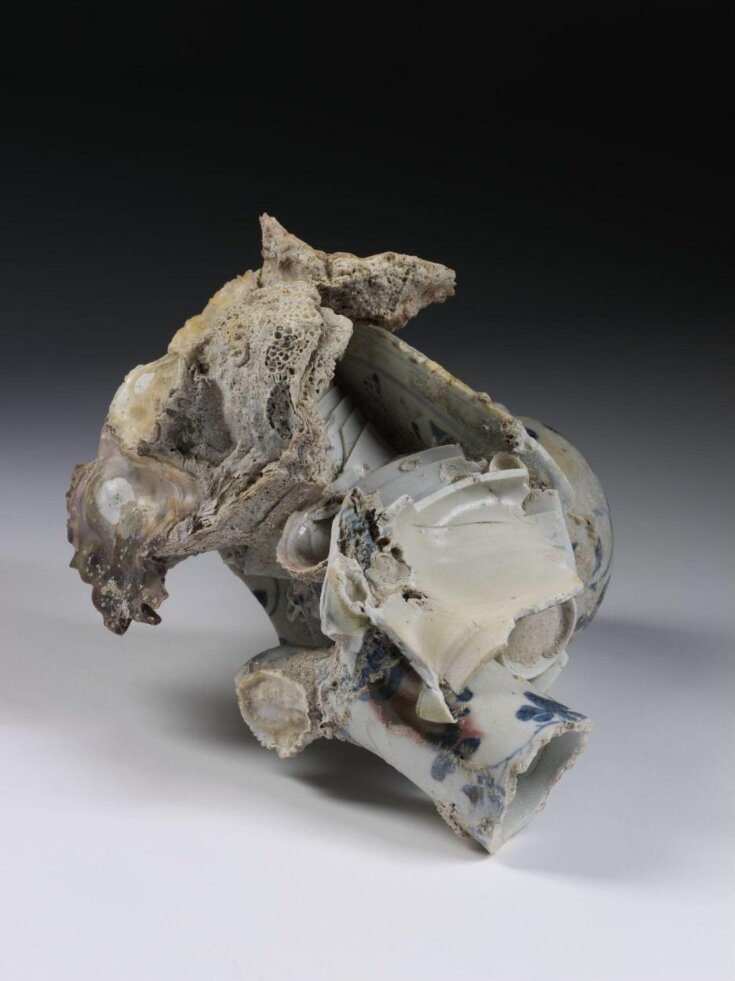
The object in the Victoria and Albert Museum is not a sculpture that a potter planned. It is a stack of Chinese porcelain pieces, distorted together by fire, with shells and coral grown across the joined surfaces. The museum calls it a “sea sculpture.” It began as cargo aboard a ship that sank off the coast of southern Vietnam.
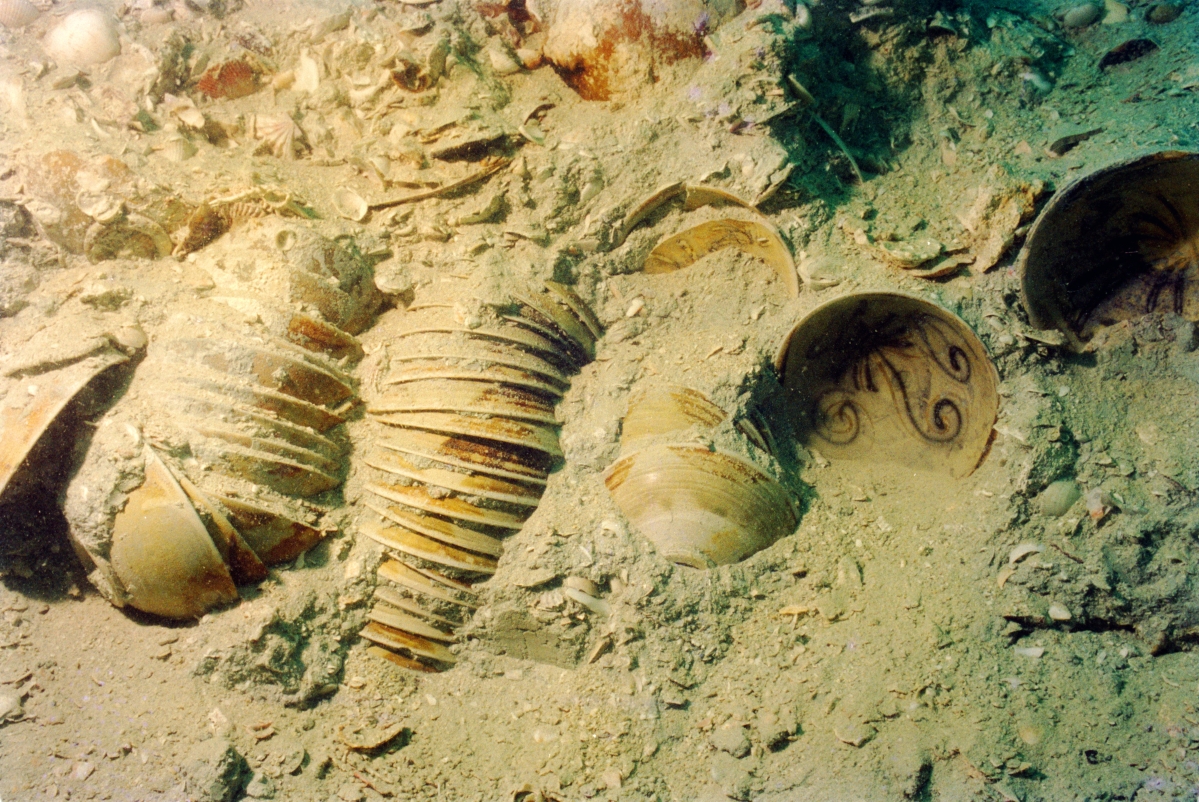
The wreck is known as the Ca Mau shipwreck, after the region where it was discovered in 1998. The V&A dates the fused porcelain to about 1725 and attributes the pieces to Jingdezhen, the major kiln center in southern China. The label “sea sculpture” describes what the seabed made of an accident: everyday vessels became a single object that could not have come from any kiln in that form.
A cargo vessel, not an art commission
The V&A identifies the wreck as probably a Chinese junk. The museum’s overview describes a vessel carrying a mixed cargo of Chinese porcelain, especially tea bowls and saucers, for Asian and European markets. It suggests the ship may have been travelling from Canton, now Guangzhou, toward Batavia, now Jakarta. The route is plausible, but the surviving record does not let us reconstruct the ship’s exact itinerary day by day.
The wreck carried a large amount of porcelain. The V&A’s object records cite 51,500 pieces recovered by 1999; a 2007 Sotheby’s sale catalogue title refers to 76,000 pieces; a later V&A overview says about 130,000 ceramics were salvaged. Those figures describe different reports and stages, and the V&A pages do not reconcile them into one final count. The safest conclusion is scale: the wreck preserved a major commercial cargo, not a small personal collection.
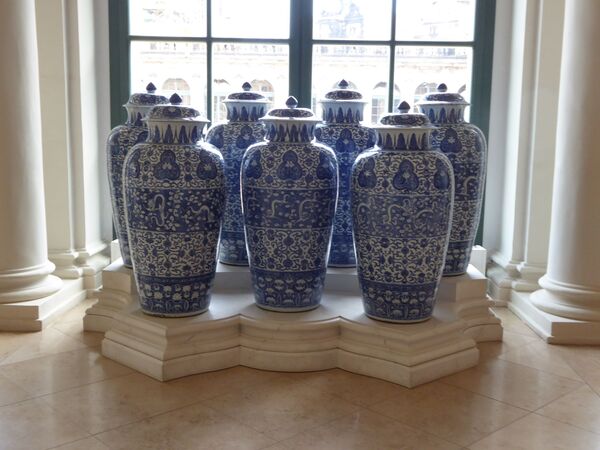
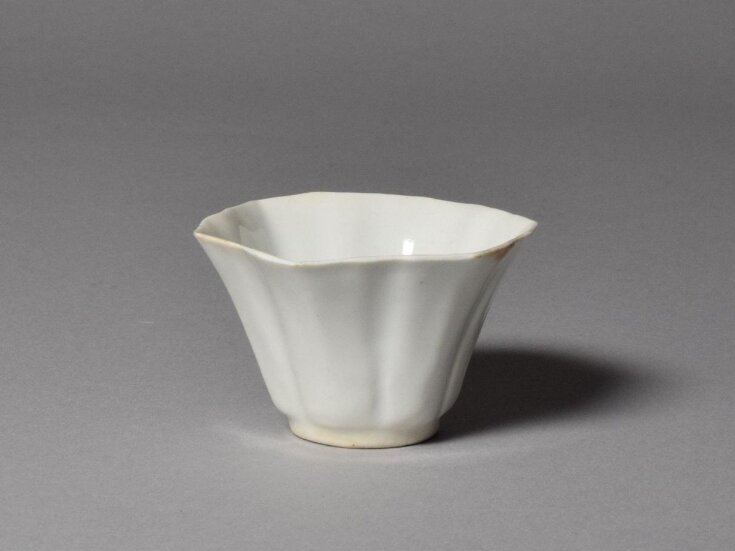
The cargo also reminds us that Jingdezhen wares travelled through several markets. Some pieces were intended for buyers in Asia; others entered longer-distance trade that carried Chinese porcelain toward Europe. A ship’s hold held goods in quantity, but each bowl, bottle, and spittoon still began as a separate, mass-produced object in a kiln town.
How the fire changed the cargo
V&A object FE.7-2007 is described as several underglaze-blue porcelain pieces fused together, including a spittoon, a stack of tea bowls, and the neck of a vase. Its recorded dimensions are 17 by 22 centimetres. Object FE.8-2007 is a different arrangement: a stack of blue-and-white cups fused to a growth of coral.
The museum says a fire aboard the ship fused the porcelain and may have caused the wreck. That causal link remains a possibility, not a witnessed fact. The objects were later altered again by the seabed. Shells and coral attached to the fused pieces while they lay underwater, producing the sculptural surface that makes the surviving cargo look unlike a typical ceramic collection.
The second object is recorded as 20 centimetres high, 22 centimetres long, and 17.5 centimetres wide. It is not just the FE.7 spittoon stack seen from another side: the V&A catalogue describes FE.8 as a separate group of cups joined to a coral growth. The museum holds 182 pieces from the wreck. Two carefully catalogued examples cannot recreate the entire hold, but they show how individual shapes can still be recognized inside an accidental mass.
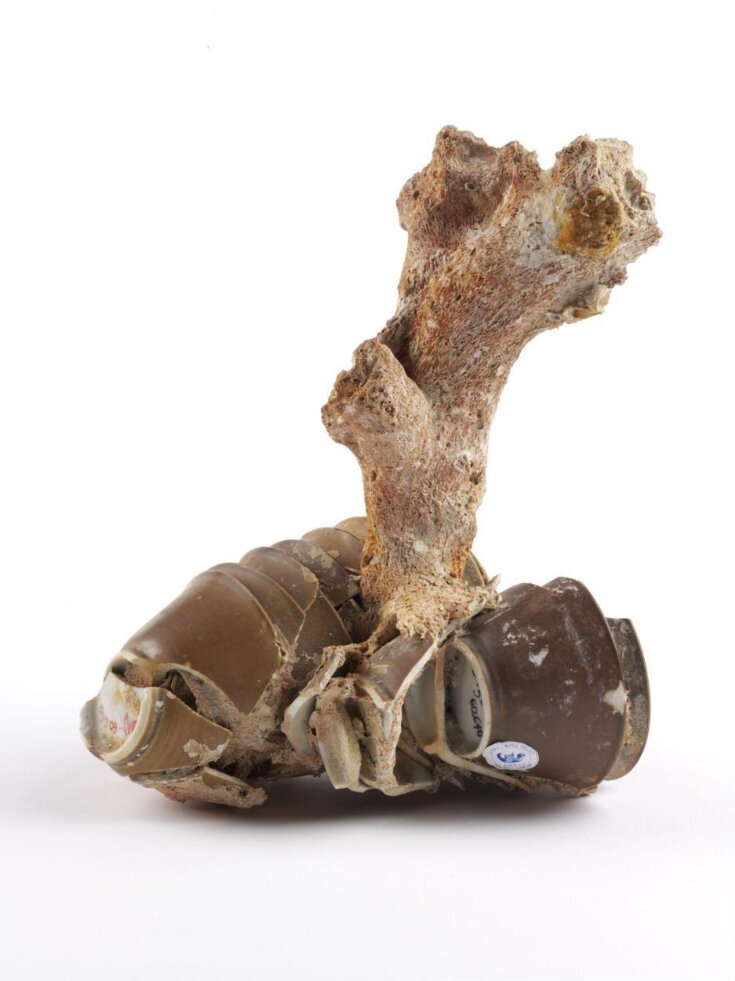
Image Source: Victoria and Albert Museum (Object FE.8-2007).
The sea did not turn the porcelain into a work of art by intention. Rather, fire and marine growth changed how the objects could be read. The museum record still identifies their original forms—cups, a spittoon, and a vase neck—even though the fused mass now has a new outline. The result is both evidence of cargo and an accidental composition.
What two museum objects can—and cannot—tell us
The V&A acquired 182 objects from the wreck through a 2007 sale in Amsterdam. That collection gives researchers examples of the forms, decoration, and production of Chinese porcelain that had been packed for export. It does not represent every item carried on the ship, and two sea sculptures cannot tell us the complete arrangement of the cargo or the sequence of events before the vessel sank.
The date “about 1725” is approximate. The wreck’s identity, its course, and the precise cause of its loss remain uncertain. It would be misleading to describe the fire as a confirmed accident or to treat the museum’s suggested route as a ship’s log. What can be said is narrower but still compelling: the porcelain was made in Jingdezhen, the wreck was found near Ca Mau, and the cargo’s later condition records a combination of fire and long immersion. “Ca Mau wreck” is a geographic label for a find, not the ship’s documented name. The objects cross modern national boundaries—made in China, recovered in Vietnam, collected in London—so their route matters as much as their style.
The Ca Mau objects belong to a larger history of shipwrecked Chinese ceramics, but they are not the same story as the Song-dynasty cargo of Nanhai No. 1 or the Tang ceramics recovered from the Belitung wreck. Different routes, dates, and wares sit behind each site. The Ca Mau “sea sculptures” are distinctive because the shipwreck itself changed the objects’ physical form.
From cargo to a new object biography
The V&A’s records give the pieces two histories. One is industrial: the forms were mass-produced at Jingdezhen for export. The other began aboard the ship: a fire fused some pieces, and after the ship went down, shells and coral grew over them. The museum’s work preserves both readings without pretending that the accident can be reconstructed in full.
The porcelain was made for use and trade. The sculpture-like objects that survive are products of loss, recovery, and the sea. They make visible an unusual moment when the commercial cargo of an eighteenth-century ship became, by accident, a one-of-a-kind museum object.
“Sea sculpture” is a modern museum description, not a name from the ship’s manifest. The V&A record attributes the maker as unknown and traces where the pieces were found and where the porcelain was produced. That distinction keeps the object’s new form in view without pretending we know what the ship’s crew thought of it before the fire.
References
Victoria and Albert Museum. (2024, April 17). Shipwrecked ceramics. https://www.vam.ac.uk/articles/shipwrecked-ceramics
Victoria and Albert Museum. (n.d.). Sea sculpture (Object FE.7-2007). https://collections.vam.ac.uk/item/O172836/sea-sculpture-unknown/
Victoria and Albert Museum. (n.d.). Sea sculpture (Object FE.8-2007). https://collections.vam.ac.uk/item/O172856/sea-sculpture-unknown/